

If you have owned your home in Ocean County for years, your equity may be your largest asset. Maybe you bought in Toms River in the 1990s, rebuilt a Brick or Seaside Park home after Superstorm Sandy, or paid down a mortgage on a family shore house. Now debt has caught up with you, and one question keeps you up at night: “Will bankruptcy cost me my house?”
For most homeowners with significant equity, the answer depends on choosing the right chapter and building the right plan. New Jersey law makes that choice more important than in almost any other state.
Why Home Equity Is Harder to Protect in New Jersey
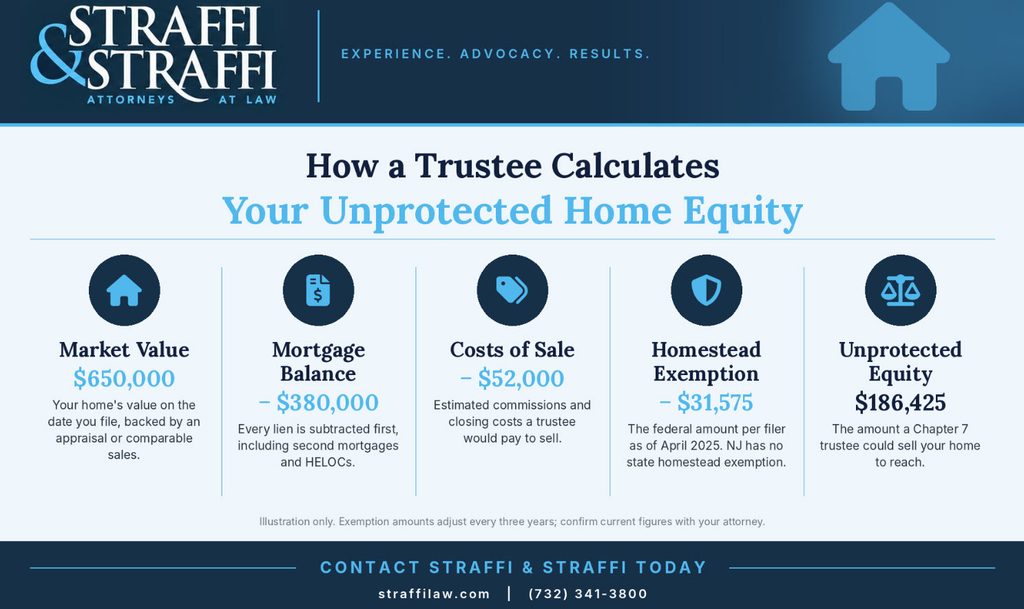
Most states have a homestead exemption that shields some or all of your equity. New Jersey does not have one. Instead, New Jersey filers can choose the federal bankruptcy exemptions, and the federal homestead exemption is modest.
As of April 1, 2025, the federal amounts are:
- Homestead exemption: $31,575 per filer in your primary residence
- Wildcard exemption: $1,675, plus up to $15,800 of any unused homestead amount
- Married couples filing jointly: each spouse who owns the home can generally claim the homestead exemption, for up to $63,150
These amounts adjust every three years. Confirm the current figures with your attorney before you file.
For a home worth $650,000 with a $380,000 mortgage, the gap between real equity and protected equity can be well over $100,000. That gap is what puts homes at risk.
What Happens to a Home With Equity in Chapter 7
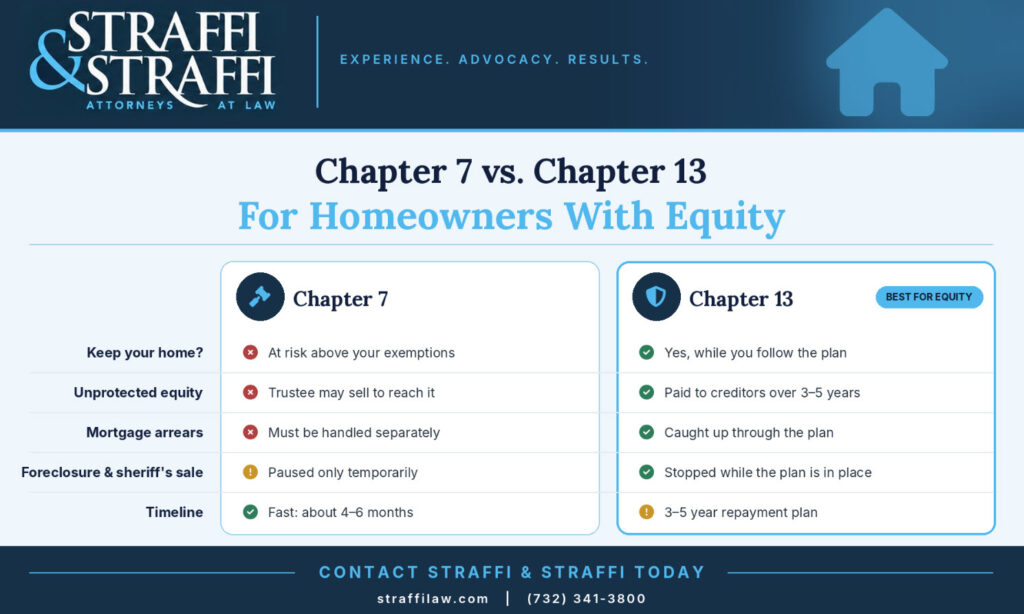
In a Chapter 7 bankruptcy, a trustee collects and sells non-exempt property to pay creditors. If your home has equity beyond your exemptions, after the mortgage and the costs of a sale, the trustee has a strong reason to sell it.
That is why Chapter 7 is usually a poor fit for homeowners with substantial equity. It works best for people with little or no unprotected equity, or for people willing to give up the property.
How Chapter 13 Protects Your Home
Chapter 13 bankruptcy works differently. You keep your property, including a home with equity, and repay creditors through a court-approved plan lasting three to five years.
The trade-off is a rule called the best interest of creditors test. Your unsecured creditors must receive at least as much through your plan as they would have received if the home had been sold in a Chapter 7 case. In plain terms, you “buy back” your unprotected equity over time instead of losing the house.
Chapter 13 can also:
- Stop a pending foreclosure or sheriff’s sale through the automatic stay
- Let you catch up on mortgage arrears over the life of the plan
- Spread payments on non-exempt equity across up to 60 months
How Bankruptcy Courts Value Your Home
Because the equity number drives your plan, valuation is one of the most important parts of your case. Your home is generally valued as of the date you file, not the date you bought it or a future sale date.
Your attorney will typically support the value with:
- A professional appraisal or broker price opinion
- Comparable sales in your neighborhood
- Evidence of condition issues, such as flood damage, roof or foundation problems, or deferred repairs
A trustee or creditor can challenge your value. A well-documented valuation of a Lavallette bungalow or a Toms River colonial can reduce the equity you must pay for by tens of thousands of dollars.
How Equity Affects Your Chapter 13 Plan Payments
Your monthly plan payment is shaped by two separate tests, and the higher result controls:
- The disposable income test. What you can afford after reasonable living expenses, based on your income.
- The best interest test. The total your unsecured creditors must receive, based largely on your non-exempt equity.
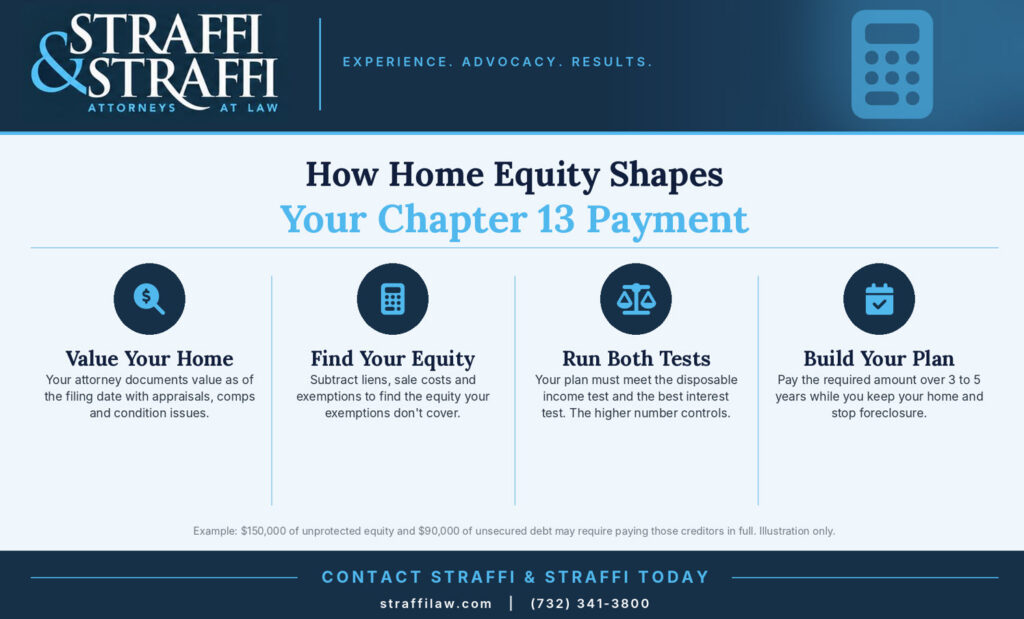
For example, if your unprotected equity is about $150,000 and your unsecured debts are $90,000, your plan may need to pay those creditors in full. If your unsecured debts are $250,000, your plan needs to pay roughly what a Chapter 7 sale would have produced, not the full balance. These are illustrations, not guarantees.
Strategies That Can Help Protect More Equity
Depending on your situation, an experienced attorney may consider:
- Filing jointly so both spouses can claim exemptions
- Reviewing how title is held. New Jersey homes owned by spouses as tenants by the entirety may receive special protection, which can change which exemption scheme makes sense.
- Timing the filing around valuation, refinancing, or a planned sale
- Selling the home through the plan on your schedule rather than the trustee’s, if keeping it isn’t realistic
Protect What You’ve Built, Starting with a Free Consultation

Decades of mortgage payments shouldn’t disappear because of a few hard years.
Daniel Straffi, Jr. has guided New Jersey homeowners through bankruptcy for more than 20 years and serves as Co-Chair of the Ocean County Bar Association Bankruptcy Panel.
Schedule a free consultation or call (732) 341-3800 to explore how to protect home equity with bankruptcy in New Jersey.
Answers to Your Bankruptcy and Home Equity Questions
Does New Jersey have a homestead exemption?
No. New Jersey filers usually rely on the federal homestead exemption, which is $31,575 per filer as of April 2025.
Can I protect a vacation home or shore house in bankruptcy?
The homestead exemption covers only your primary residence. Equity in a second home is usually exposed, though Chapter 13 can let you keep it by paying its value through the plan.
What if my home rises in value during my Chapter 13 plan?
In most Chapter 13 cases, equity is measured at filing, so later appreciation typically benefits you. Ask your attorney how your court handles it.
Can I refinance during Chapter 13 to pay off my plan early?
Yes, with court approval. Some homeowners refinance or sell to pay the plan off early once their finances recover.
Does a reverse mortgage affect my bankruptcy?
Yes. A reverse mortgage reduces your equity, and the lender’s balance grows over time. Your attorney will factor it into your valuation and plan.
Will the trustee inspect my house?
Sometimes. Trustees may request an appraisal or an interior inspection, especially when equity is close to the exemption limit.
Can I keep my home if only my spouse files bankruptcy?
Often, yes. How the home is titled matters, and filing individually may change how much equity is exposed.
Does an inherited home qualify for the homestead exemption?
Only if it’s your primary residence when you file. Inheriting property within 180 days of filing can also bring it into your case.
Can I use bankruptcy to stop a partition or co-owner sale?
The automatic stay can pause many collection actions, but disputes with co-owners are complex. Get advice before the court acts.
Is Chapter 11 an option for homeowners with very high debt?
Yes. Homeowners whose debts exceed Chapter 13 limits may consider Chapter 11.


