
Receiving a foreclosure notice is one of the most frightening experiences a homeowner can face. The thought of losing your home — the place where your family lives, makes memories, and finds stability — can feel paralyzing. But if you’re a New Jersey homeowner behind on mortgage payments, you may have a powerful legal tool available to you: Chapter 13 bankruptcy.
At Straffi & Straffi Attorneys at Law, we have helped countless families throughout Ocean County, Monmouth County, and Central and Southern New Jersey use Chapter 13 bankruptcy to stop foreclosure, catch up on missed payments, and keep their homes. In this guide, we’ll explain exactly how the process works, who qualifies, and what steps to take before it’s too late.
What Is Foreclosure in New Jersey?
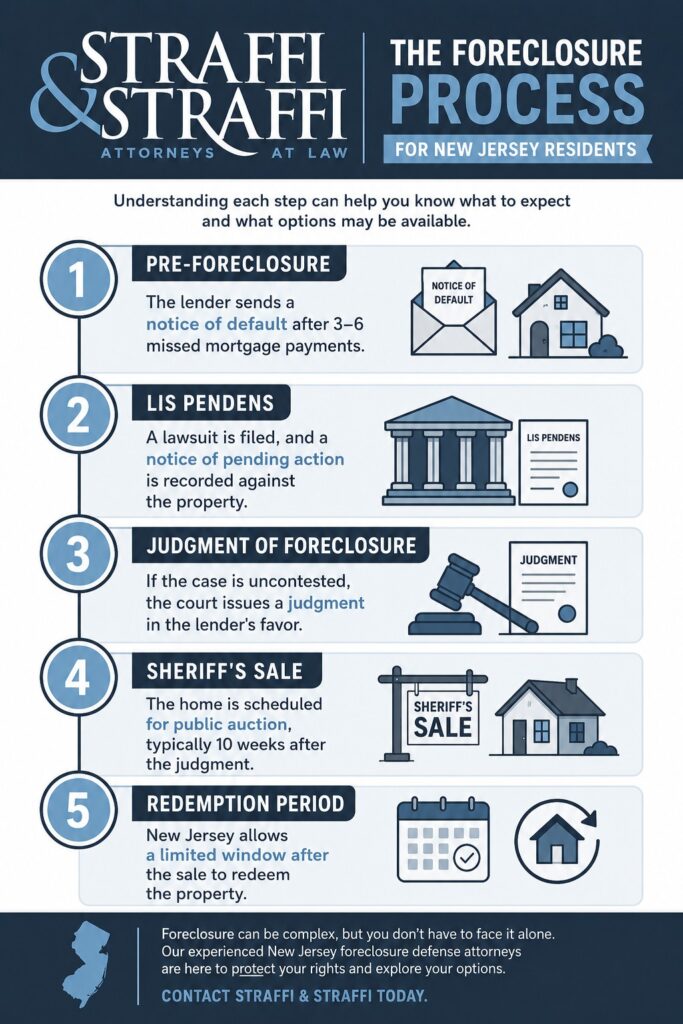
Foreclosure is the legal process by which a mortgage lender reclaims a property after a borrower falls behind on payments. New Jersey is a judicial foreclosure state. Lenders must file a lawsuit and obtain a court order before they can sell your home. This process typically takes anywhere from 3 to 36 months, depending on case complexity and court backlog. Once a sheriff’s sale is scheduled, time becomes critically short.
The New Jersey foreclosure process generally follows these stages:
How Chapter 13 Bankruptcy Stops Foreclosure
Chapter 13 bankruptcy — also known as “reorganization bankruptcy” or the “wage earner’s plan” — is specifically designed for individuals with regular income who want to repay their debts over time rather than liquidate their assets.
Unlike Chapter 7 bankruptcy, which involves selling off non-exempt assets, Chapter 13 lets you keep your home while restructuring what you owe.
Homeowners with mounting debts often choose to file Chapter 13 because:
- It triggers an automatic stay the moment you file. All collection actions, lawsuits, and foreclosure proceedings must stop immediately.
- It allows you to pay mortgage arrears over time. Rather than paying all missed payments at once, you can spread the overdue balance across a 3- to 5-year repayment plan.
- It protects your home from a sheriff’s sale. As long as you comply with your repayment plan, your lender cannot proceed with the sale.
- It can eliminate or reduce other unsecured debts such as credit cards and medical bills — freeing up income to make your mortgage payments going forward.
The Automatic Stay is Your Immediate Shield Under New Jersey Law
The automatic stay is one of the most effective tools for preventing foreclosure. Under 11 U.S.C. § 362, the moment your bankruptcy petition is filed with the U.S. Bankruptcy Court for the District of New Jersey, the automatic stay goes into effect, before a judge reviews your case.
The automatic stay legally requires your mortgage lender to:
- Halt all foreclosure proceedings currently underway
- Cancel any scheduled sheriff’s sale (or postpone it indefinitely while the case is active)
- Stop all collection calls and written contact
- Cease wage garnishments and bank levies
This immediate protection gives you valuable time to reorganize your finances and work with your Chapter 13 bankruptcy attorney on a feasible repayment plan. In emergencies where a sheriff’s sale is days away, an experienced New Jersey bankruptcy attorney can file on an emergency basis to stop the sale before it occurs.
How the Chapter 13 Repayment Plan Works for Homeowners Facing Foreclosure
Under Chapter 13, you propose a 3- to 5-year repayment plan to the bankruptcy court. This plan is built around your income, living expenses, and the nature of your debts.
Mortgage Arrears (Past-Due Payments)
Mortgage arrears are treated as a priority secured debt. The total amount, including missed payments, late fees, and certain foreclosure-related costs, is divided over the length of your repayment plan.
For example, if you owe $18,000 in arrears and your plan spans 60 months, that works out to approximately $300 per month paid through the trustee.
Ongoing Mortgage Payments
You must continue making your regular monthly mortgage payments directly to your lender throughout the plan. Missing these payments could jeopardize your case.
Unsecured Debts
Unsecured debts like credit cards and medical bills are typically paid at a fraction of their total balance, or in some cases, discharged entirely at the end of the plan.
The Chapter 13 trustee collects your monthly plan payment and distributes funds to your creditors. Creditors cannot contact you directly during this period.
At the successful completion of your plan, your mortgage arrears are fully resolved, your remaining eligible unsecured debts may be discharged, and you emerge from bankruptcy as a homeowner with a fresh financial start.
Which Homeowners Qualify for Chapter 13 in New Jersey?
To file for Chapter 13 bankruptcy in New Jersey and prevent foreclosure, you must meet certain eligibility requirements:
- Regular income
You must have a stable source of income — wages, self-employment earnings, Social Security, pension, or other regular payments — sufficient to fund your repayment plan.
- Debt limits
As of 2026, your total secured debt (for example, mortgages, car loans) must be below approximately $1,580,125, and your unsecured debt below approximately $526,700. These figures are periodically adjusted for inflation.
- Credit counseling
You must complete an approved credit counseling course within 180 days before filing.
- Prior bankruptcy history
If you received a Chapter 7 discharge within the past 4 years, or a Chapter 13 discharge within the past 2 years, you may be ineligible for a new discharge — though you may still be able to file for the protection it offers.
Our guide to Chapter 13 bankruptcy in New Jersey can help answer your questions and determine the next steps.
Not sure if you qualify? The attorneys at Straffi & Straffi offer free foreclosure consultations to evaluate your situation and determine whether Chapter 13 is the right path for you.
The New Jersey Foreclosure Timeline: Why Acting Quickly Matters
Many New Jersey homeowners make the mistake of waiting too long, hoping their lender will work out a solution or that the process will somehow stall on its own. New Jersey foreclosure proceedings, while sometimes slow, can accelerate quickly, particularly once a final judgment is entered.
Here’s why timing matters in Chapter 13 foreclosures:
- Once a sheriff’s sale date is set, you may have as little as 10 days before the auction occurs.
- Filing Chapter 13 even hours before a sheriff’s sale can legally stop it — but this requires immediate action and an experienced attorney.
- The longer you wait, the more mortgage arrears accumulate, making your repayment plan more expensive and harder to sustain.
- Emergency bankruptcy filings are available when time is running out, but they require a knowledgeable attorney who can act quickly.
If you have received a foreclosure-related notice or know that your home is scheduled for a sheriff’s sale, contact an attorney today.
.
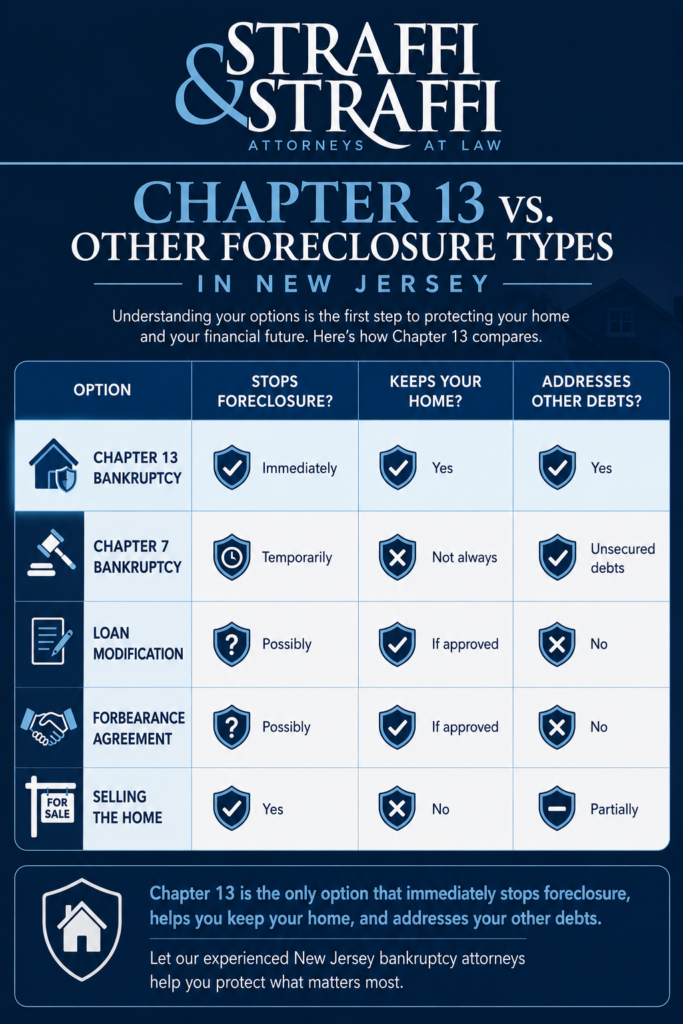
While loan modifications and forbearance agreements can be useful tools, they depend entirely on lender approval and offer no guaranteed protection. Chapter 13 bankruptcy, by contrast, provides immediate, court-ordered protection from the moment the petition is filed. No lender approval is required.
At Straffi & Straffi, we can help you evaluate all available options, including loan modifications, to determine which path gives your family the best chance of keeping your home.
Foreclosure and Chapter 13 Bankruptcy in New Jersey – Answers to Your Questions
Can Chapter 13 stop a sheriff’s sale that’s already been scheduled in New Jersey?
Yes. Filing a Chapter 13 bankruptcy petition triggers an automatic stay that legally halts a scheduled sheriff’s sale, even if the sale is only days away. However, you must file before the sale is completed. If you are facing an imminent sale date, contact an attorney immediately to file an emergency Chapter 13 application.
Will I lose my home if I file for Chapter 13 bankruptcy?
No. Keeping your home is the primary purpose of Chapter 13. As long as you make your required plan payments and keep up with ongoing mortgage payments throughout the plan, your lender cannot proceed with foreclosure.
How does Chapter 13 help me catch up on missed mortgage payments?
Chapter 13 does not erase your past-due mortgage balance. It allows you to roll your missed payments (known as arrears) into a court-supervised repayment plan lasting between 3 and 5 years. This means you do not have to come up with a massive lump sum to save your home. As long as you make your consolidated plan payments to the bankruptcy trustee and resume paying your regular, ongoing monthly mortgage payments, the foreclosure remains paused, and you get to keep your house.
Can Chapter 13 eliminate a second mortgage on my home?
Potentially, yes, through a legal process known as lien stripping. In New Jersey, if the current fair market value of your home has dropped so much that it is worth less than the balance of your first mortgage, your second or third mortgages are considered completely unsecured. In a Chapter 13 bankruptcy, the court can strip these junior liens from the property, reclassifying them like ordinary credit card debt.
You will pay a fraction of what you owe on them during your repayment plan, and whatever balance remains at the end of your 3- to 5-year term is legally discharged.
Protect Your Home Against Foreclosure – Speak with a New Jersey Chapter 13 Attorney
If you are behind on your mortgage and facing foreclosure in New Jersey, you don’t have to lose your home. Chapter 13 bankruptcy exists for situations like yours, and the experienced attorneys at Straffi & Straffi Attorneys at Law are here to help you harness it.
Father and son bankruptcy attorneys Daniel Straffi Sr. and Daniel Straffi Jr. bring a combined 40+ years of experience in bankruptcy and foreclosure law to every case. We serve clients throughout Ocean County, Monmouth County, and across Central and Southern New Jersey. Our office is conveniently located at 670 Commons Way, Suite I, Toms River, NJ 08755.
We offer in-person, phone, and video consultations, and we have flexible payment plans so that cost is never a barrier to protecting your home.
Call us today at (732) 341-3800 to schedule your free consultation.


