
Facing the prospect of losing your home is one of the most stressful and overwhelming experiences a family can endure. If you have fallen behind on your mortgage payments in New Jersey, you might be receiving threatening letters and phone calls from your lender. The fear of the unknown often makes the situation feel even worse. Learning the New Jersey foreclosure process is your first and best defense to saving your home.
New Jersey is a judicial foreclosure state, which means that a lender cannot simply take your home, change your locks, or kick you out on a whim. They must go through the state court system and follow strict legal procedures outlined under the New Jersey Fair Foreclosure Act.
The involvement of the courts means the foreclosure process takes time, often over a year from start to finish. During this timeline, you’ll have ample opportunity to fight back, negotiate a loan modification, or seek protection under federal bankruptcy laws.
This is our step-by-step breakdown of the stages of a foreclosure in New Jersey, explaining exactly what to expect and when to seek legal help.
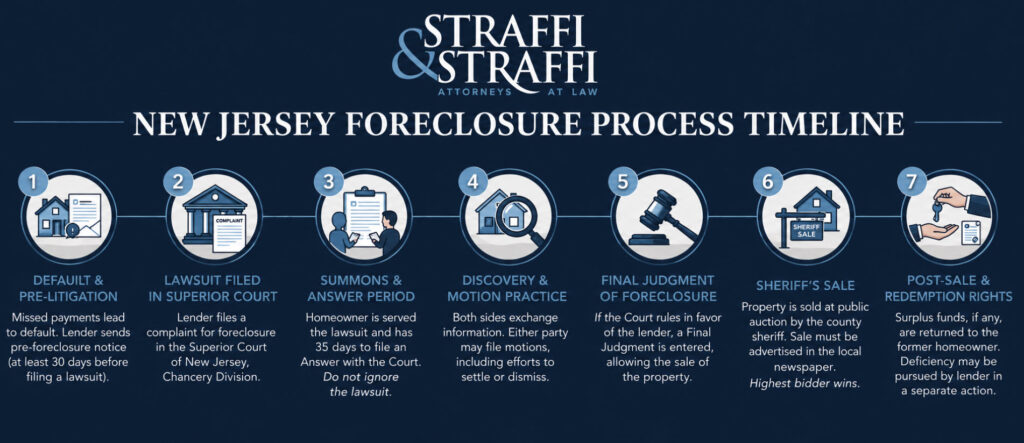
Stage 1: Default and the Notice of Intention to Foreclose (NOI)
The foreclosure process begins when you default on your mortgage. Typically, a loan is considered in default after you have missed three or more consecutive monthly payments.
Before a lender can officially file a lawsuit against you, New Jersey law strictly requires them to send a Notice of Intention to Foreclose (NOI). This notice must be sent via both certified and regular mail at least 30 days before the lender files a formal complaint in court.
The NOI is essentially a final warning. It will state exactly how much you owe in arrears and provide you with a specific timeframe (usually 30 days) to “cure the default” by paying the past-due amount. If you receive an NOI, do not ignore it or throw it in the trash. This is a critical time to contact a foreclosure defense attorney at Straffi and Straffi to explore loss mitigation options before hefty court fees and legal costs are added to your balance.
Stage 2: The Foreclosure Complaint and Lis Pendens
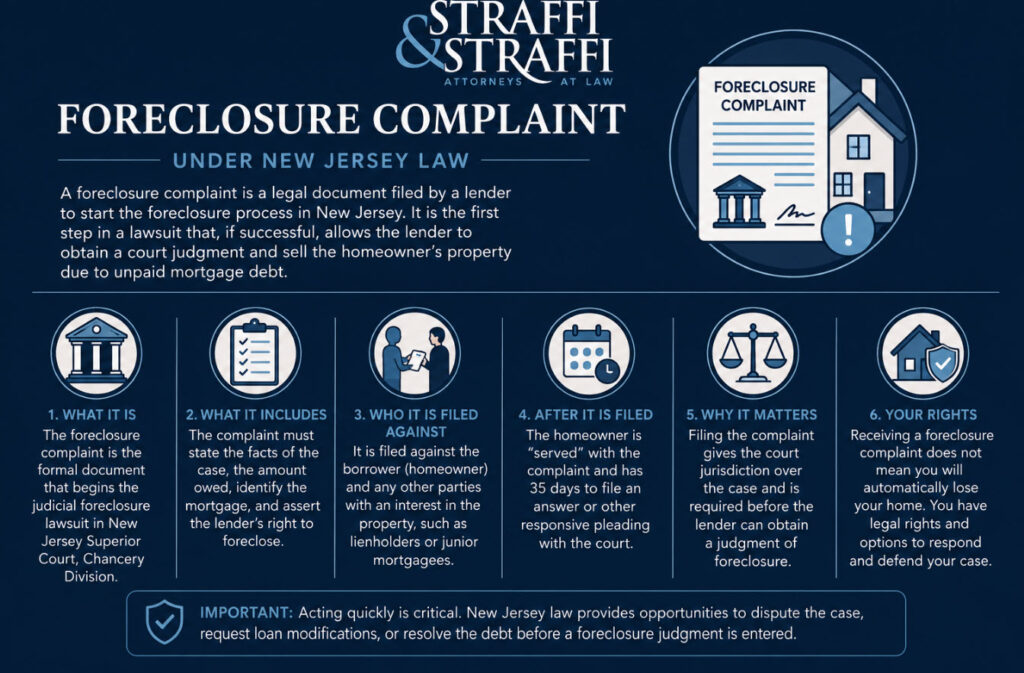
If the 30-day cure period expires and the default is unresolved, the lender’s attorneys will file a Foreclosure Complaint with the Office of Foreclosure in the New Jersey Superior Court. This document is the official start of the lawsuit against you.
Simultaneously, the lender will file a Lis Pendens (Latin for “suit pending”) with the county clerk in the county where your property is located. This is a formal public notice indicating that the property is subject to an active legal dispute.
A Lis Pendens will prevent you from easily selling or refinancing the home without first addressing the underlying mortgage debt.
You will be formally served with the Foreclosure Complaint via a process server or sheriff’s deputy. Being served with court papers at your front door can be deeply intimidating, but it is crucial to remember that receiving a complaint does not mean you have lost your home. You still have rights.
Stage 3: The 35-Day Deadline to File an Answer and Mediation
Once you are served with the Foreclosure Complaint, the legal clock starts ticking. Under New Jersey law, you have exactly 35 days to file a Contesting Answer with the court.
This is the stage where having an experienced attorney becomes vital. A Contesting Answer raises affirmative legal defenses against the foreclosure. For example, the lender may have violated the Fair Foreclosure Act, they may lack the legal standing to sue you (often due to lost or improperly transferred mortgage notes), or they may have miscalculated your escrow. If you file a Contesting Answer, your case is sent to a judge in the Chancery Division for litigation. This forces the lender to prove their case and gives you immense leverage to negotiate. If you fail to respond within the 35 days, the court assumes you do not contest the foreclosure.
You also retain the right to participate in the New Jersey Foreclosure Mediation Program. This state-sponsored program brings you, your attorney, and the lender’s representatives to the table with a neutral mediator to discuss alternatives to foreclosure, such as loan modifications or repayment plans.
Stage 4: Entry of Default and Final Judgment
If you do not file an Answer, or if your Answer is ultimately struck down by the judge, the lender will request an Entry of Default. This signifies that the lender has won the initial phase of the lawsuit by default.
Following this, the lender will apply for a Final Judgment. Before doing so, they legally must send you a “Notice of Intent to Enter Final Judgment,” granting you a final 14-day window to respond. The Final Judgment calculates the exact, down-to-the-penny amount you owe the lender, which will include your principal balance, interest, late fees, court costs, and the bank’s attorney’s fees.
Once the judge signs the Final Judgment, a Writ of Execution is issued. This powerful document legally authorizes your county sheriff to sell your property at a public auction to satisfy the debt.
Stage 5: The Sheriff’s Sale
The lender will forward the Writ of Execution to the sheriff in the county where your home is located to schedule a Sheriff’s Sale. The date of the sale must be published in local newspapers for four consecutive weeks, and a notice must be physically posted on your property.
Even at this late stage, New Jersey provides homeowners with a statutory lifeline. Under state law, you are entitled to two statutory adjournments (delays) of the Sheriff’s Sale. Each adjournment postpones the sale for up to 30 days, giving you up to 60 additional days of breathing room. You do not need a judge’s permission or a complex legal reason for these first two adjournments; you request them from the county sheriff and pay a nominal administrative fee (typically $28).
If you need more time after exhausting your statutory adjournments, a foreclosure defense lawyer can file an emergency motion with a judge to stay (stop) the sale, provided there is a valid legal reason, such as a pending loan modification review.
Further potential valid legal reasons to stop a sheriff’s sale include:
- Improper Notice or Procedural Errors
The lender or sheriff failed to strictly follow state laws regarding publicizing the sale, posting notices, or serving you with the proper paperwork.
- Federal “Dual-Tracking” Violations
The lender is moving forward with the sale while you have a complete loss mitigation application (like a loan modification request) pending review, which is a violation of federal rules.
- Lack of Standing
The lender cannot produce the proper documentation proving they legally own the mortgage note and have the right to foreclose.
- Pending Short Sale or Deed in Lieu
You have a legitimate, pending agreement to sell the home via a short sale or surrender it through a deed in lieu of foreclosure.
Stage 6: The Right of Redemption and Eviction
If the property is ultimately sold at the Sheriff’s Sale, the process is still not over. New Jersey allows a 10-day statutory Right of Redemption immediately following the sale.
During this brief 10-day window, you can reclaim your home by paying the full amount owed on the final judgment, plus costs. Alternatively, if you believe the sale was conducted improperly or fraudulently, your attorney can file a motion to object to the sale during these 10 days.
Once the 10-day period expires without redemption or objection, the winning bidder (which is often the bank itself) receives the deed to the property. Only at this moment do you lose legal ownership. If you have not vacated the premises, the new owner must obtain a Writ of Possession to have you legally evicted by the sheriff. A lender cannot independently change your locks or remove your belongings without a court order.
How Straffi and Straffi Can Protect Your Home

New Jersey Foreclosure Defense Attorney Danielre Straffi, Jnr.
At Straffi and Straffi, we have extensive experience helping New Jersey families navigate and fight the foreclosure process.
Depending on your unique financial situation, our legal team can help you in several ways:
- Aggressive Foreclosure Defense
We can scrutinize the lender’s paperwork, challenge their standing, and file a Contesting Answer to fight the foreclosure in court.
- Negotiating a Loan Modification
We can work directly with your lender to restructure your mortgage, lower your interest rate, or fold your past-due arrears into a new loan so you can resume affordable monthly payments.
- Filing for Chapter 13 Bankruptcy
If a Sheriff’s Sale is imminent, filing for Chapter 13 bankruptcy immediately triggers an “automatic stay,” which legally halts the foreclosure and stops the Sheriff’s Sale in its tracks. Our team can help you file Chapter 13 and restructure your debt so you can catch up on missed mortgage payments over a 3- to 5-year period.
Time is your most valuable asset when facing foreclosure. The earlier you seek legal counsel, the more options are available to you.
If you have received a Notice of Intention to Foreclose, a Foreclosure Complaint, or notice of a Sheriff’s Sale, contact Straffi and Straffi today for a consultation. Let us put our deep understanding of New Jersey law to work for you and help you save your home


