
If you’re considering Chapter 13 bankruptcy in New Jersey, the question on most people’s minds relates to their assets. They want to know whether they will lose their car, home, or retirement accounts when filing for Chapter 13. The worry is they’ll lose assets in Chapter bankruptcy filings.
Here’s the short answer: in most Chapter 13 cases, you keep everything you own. Unlike Chapter 7, Chapter 13 bankruptcy is a repayment plan, not a liquidation. As long as you keep making your plan payments, New Jersey’s exemption laws and the structure of Chapter 13 enable you to keep your home, vehicle, retirement savings, and your personal belongings.
This guide breaks down exactly which assets are protected, how New Jersey’s exemption system works, and how to safeguard what matters most to you.
Key Takeaways
- Chapter 13 is a repayment plan that allows you to keep your property as long as you complete the payments.
- New Jersey allows filers to choose between state exemptions and federal bankruptcy exemptions, whichever protects more.
- Retirement accounts (401(k)s, IRAs, pensions) are almost always fully protected.
- Home equity above the exemption limit doesn’t force a sale in Chapter 13 — it raises what you must pay unsecured creditors instead.
- Non-exempt asset value above your exemptions still needs to be accounted for in your repayment plan, even though you don’t lose the asset.
Chapter 13 vs. Chapter 7: Why It Matters for Your Assets
In Chapter 7 bankruptcy, a trustee can sell non-exempt property to pay creditors. In Chapter 13, you propose a three- to five-year repayment plan to pay back some or all of your debts.
The trade-off is that any equity you have in non-exempt assets must be factored into your plan payments under the best interests of creditors test. Your unsecured creditors must receive at least as much through your plan as they would if your non-exempt assets were sold in a Chapter 7 case. You don’t lose the property. You pay its non-exempt value over time instead.
| Filing Element | Chapter 7 | Chapter 13 |
| How debts are handled | Non-exempt assets sold | Repaid via 3–5 year plan |
| Risk to home/car | Possible if equity exceeds exemptions | Kept if payments stay current |
| Income requirement | Must pass means test | Requires steady income |
| Effect on non-exempt equity | Asset may be liquidated | Equity value added to plan payments |
| Typical duration | 4–6 months | 3–5 years |
New Jersey Exemptions: State vs. Federal
New Jersey is one of the states that allows filers to choose between the New Jersey state exemption set and the federal bankruptcy exemption set (11 U.S.C. § 522(d)). Many New Jersey filers choose the federal exemptions because they include a homestead exemption that New Jersey’s own state law lacks.
| Asset Type | Federal Exemption (2025–2028, per filer) | New Jersey State Exemption |
| Homestead (home equity) | $31,575 | No specific homestead exemption |
| Motor vehicle | $5,025 | Must use the $1,000 personal property allowance |
| Wildcard (any property) | $1,675 + up to $15,800 unused homestead | No wildcard; limited to $1,000 general personal property exemption |
| Retirement accounts | Fully exempt (with IRA caps at $1,711,975) | Fully exempt under state and federal non-bankruptcy law |
| Household goods | Up to $800/item, $16,850 total | Broadly protected as personal property |
| Tools of the trade | $3,175 | Protected up to $1,000 |
| Public benefits | Fully exempt | Fully exempt |
Exemption dollar amounts adjust periodically under federal law; confirm current figures with a bankruptcy attorney before filing.
Married couples filing jointly in New Jersey can typically double each exemption amount, which is one reason many couples choose the federal set when they own a home with meaningful equity.
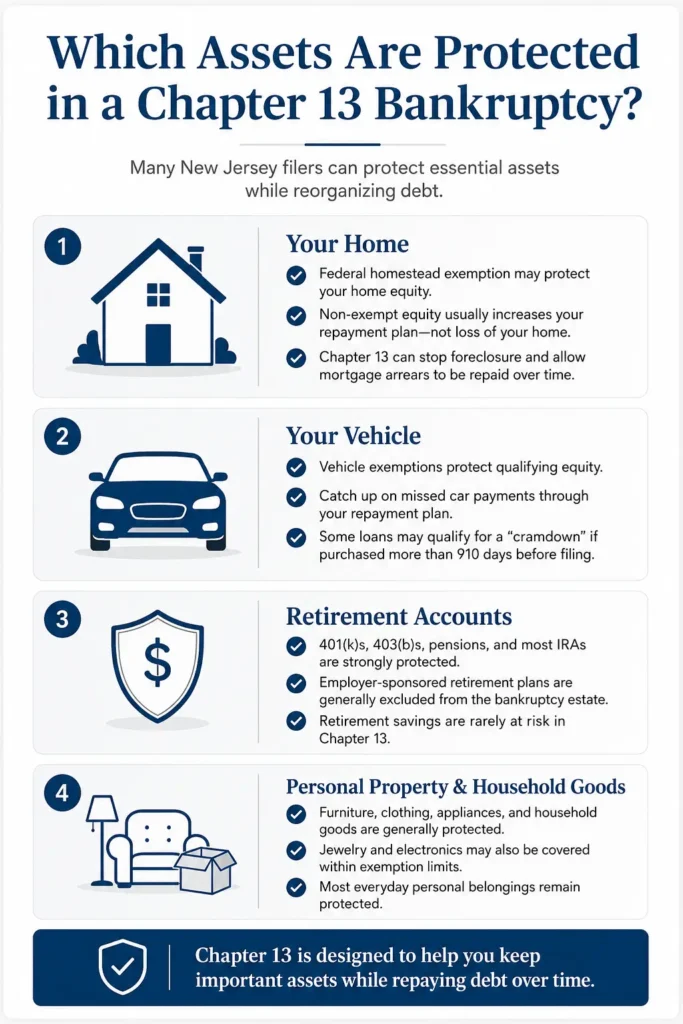
Which Assets Are Protected In a Chapter 13 Bankruptcy?
Your Home
Because New Jersey lacks its own homestead exemption, most filers rely on the federal homestead exemption to protect home equity.
If your equity exceeds the exemption amount, you don’t automatically lose the house in Chapter 13. The non-exempt equity increases what you must pay unsecured creditors over the life of your plan. Chapter 13 is also the tool most commonly used to catch up on mortgage arrears and stop a scheduled foreclosure sale, since the plan lets you spread missed payments out over years while you keep making current payments. Our guide to stopping foreclosure through Chapter 13 in New Jersey explains this process in detail.
Your Vehicle
Cars are protected up to the federal or state vehicle exemption amount, and any remaining wildcard exemption can often cover the rest.
If you’re behind on car payments, Chapter 13 also lets you catch up on arrears through the plan rather than risking repossession. In some cases, filing can reduce what you owe on the loan through a process called a cramdown if the vehicle was purchased more than 910 days before you file.
Retirement Accounts
401(k)s, 403(b)s, most pensions, and IRAs (up to a federal cap for traditional and Roth IRAs) are protected under both New Jersey and federal law.
Retirement accounts are also excluded from your bankruptcy estate under ERISA in most employer-sponsored plans. This exemption is one of the strongest in bankruptcy law, and retirement savings are rarely at risk in a Chapter 13 case.
Personal Property and Household Goods
Chapter 13 filings also protect furniture, appliances, clothing, and ordinary household items through the personal property exemptions. Jewelry, electronics, and other higher-value items may need to be itemized and valued, but rarely exceed exemption limits for the average filer.
What Happens If an Asset Isn’t Fully Exempt?
The value of non-exempt assets is weighted in your repayment plan. Your Chapter 13 plan must pay unsecured creditors at least the value of your non-exempt equity across the plan term.
The Straffi & Straffi team has decades of experience advising on exemption stacking to minimize your repayment plan costs month-to-month.
The First Step to Protecting Your Assets is Speaking with a New Jersey Bankruptcy Attorney at Straffi & Straffi
Exemption planning is one of the most important and commonly mishandled elements of filing Chapter 13 bankruptcy. Choosing the wrong exemption system, or misvaluing an asset, can mean paying more than necessary or risking property you thought was protected.
Straffi & Straffi, Attorneys at Law can review your specific assets, calculate which exemption set protects the most value in your case, and build a Chapter 13 plan around keeping what matters to you.
Schedule your consultation online or call our offices at (732) 518-9057 to speak with a seasoned bankruptcy attorney.
Answers to Your Chapter 13 Asset Questions
Am I required to take any classes to file Chapter 13?
Yes. Federal law requires all individual debtors to complete an approved credit counseling course within the 180 days before filing their bankruptcy petition. This course can be completed online, over the phone, or in person. You will receive a certificate of completion that must be filed with the court. If filing jointly with a spouse, both of you must independently complete the credit counseling requirement before filing.
Does my spouse have to file Chapter 13 with me?
No. You can file for Chapter 13 individually without your spouse filing. However, if you are legally married and living together, the bankruptcy court still requires you to disclose your spouse’s income and expenses to calculate your household’s total disposable income. If you have joint debts and only you file, your non-filing spouse will remain legally responsible for paying off the debt.
Can I keep my jewelry or other expensive items?
Yes, provided the total equity in these items falls under the federal exemption limits. Under the current federal exemptions, you can protect up to $2,125 in jewelry. For other items, you can exempt up to $800 per item, up to a total of $16,850 for combined household goods, furnishings, and clothing. If an item’s value exceeds these limits, the non-exempt portion increases the amount you must pay to unsecured creditors.
Can I sell my house or car while in a Chapter 13 bankruptcy?
You cannot sell a house or vehicle during a Chapter 13 repayment plan without first getting permission from the bankruptcy court. Because these assets are legally part of your bankruptcy estate, the court must review the proposed sale to ensure it is fair and determine what happens to any profit (equity) after paying off the loan. Your attorney will need to file a formal motion to sell the property, and the trustee and your creditors will have an opportunity to object.
What happens if my car is totaled while I am in Chapter 13?
If your car is totaled, you must immediately notify your bankruptcy attorney. The insurance payout belongs to the bankruptcy estate, not directly to you. Your attorney will need to file a motion with the bankruptcy court to allow you to use the insurance proceeds to pay off the remaining car loan balance (if any) and to use any remaining funds to purchase a replacement vehicle so you can get to work and continue your repayment plan.
What happens to checking and savings accounts under Chapter 13?
The cash in your bank accounts on the day you file for bankruptcy is considered an asset of your bankruptcy estate. To protect these funds, you must apply available bankruptcy exemptions, such as the federal wildcard exemption, which allows you to protect up to $1,675 base plus up to $15,800 of any unused portion of the homestead exemption.
Any cash that cannot be fully exempted will increase the total amount you must pay your unsecured creditors through your Chapter 13 plan.


